


@alina.malova
Gustav Magyar Mannheimer, painter from Budapest in Paris – Woman with hat and parasol
Gustav Magyar Mannheimer, painter from Budapest in Paris – Woman with hat and parasol
Couldn't load pickup availability
🎈 SOLD Gustav Magyar Mannheimer, painter from Budapest in Paris – Woman with hat and parasol
Dimensions without frame 16.3 × 10.8 cm
(with frame: 30.5 × 24.7 cm)
Hungarian painter during his stay in Paris
Technique: Oil on wooden panel
It is a late 19th-century Paris that is immediately recognizable, at a time when photography had already transformed the way images were seen and constructed: the hat, the parasol, a female figure captured as if in a snapshot. The strong lateral viewpoint rotates the figure and breaks any frontal balance. The composition is decentered and partially cropped, creating a sense of unpredictability and suspended movement, characteristic of a modern vision that approaches reality as a fragment rather than as a closed composition.
Gustav Magyar Mannheimer* (Budapest 1859 – 1937) was trained at the Academy of Budapest and later in Munich. In Vienna he came under the influence of Hans Makart, with whom he collaborated on the decorations of the Kunsthistorisches Museum. In Paris he attended the Académie Julian, a key institution for the training of foreign artists at the end of the 19th century, where masters such as Bouguereau, Lefebvre and Benjamin-Constant taught, combining solid academic principles with a fully modern visual context.
The painting depicts a young woman wearing a hat and holding a parasol, immediately evoking Paris at the fin de siècle. The lateral construction of space, the rotation of the body and the partial framing of the figure reflect a painterly language deeply influenced by photography and a new way of capturing the moment, close to Impressionist sensibilities.
The clothing provides clear elements for dating: the rigid hat worn high and the dark parasol correspond to urban female fashion between 1885 and 1895, before the appearance of more voluminous and decorative headwear in the following years.
The painting is executed on a thin wooden panel, probably cut from a paint box lid or a cigar box, as was often the case among artists working in Paris at the end of the 19th century. Such light, small supports were practical for rapid work, even outdoors. The beveled edge on the right side reveals a fragmentary support, fully consistent with an image conceived to capture an instant rather than to construct a finished academic composition.
The work is signed lower right in stylized block letters “MAGYAR MANNHEIMER.”
On the reverse are old handwritten labels in French, together with collection numbers, including the number 973 accompanied by a star and the letters “E.P.”, likely referring to an exhibition context.
Period frame with floral decoration, in Jugendstil taste
* Gustav Magyar Mannheimer was one of the founders of the Circle of Hungarian Impressionist and Naturalist painters in Budapest, playing a key role in the renewal of Hungarian painting around the turn of the 20th century. At the same time, he took part regularly in the International Art Exhibitions of the Venice Biennale (1901, 1903, 1905, 1909, 1910, 1912, 1922, 1930, 1932), representing Hungary in several editions. The official catalogue of the 1912 Venice Biennale records that an entire room of the Hungarian Pavilion was devoted to his work, confirming his established institutional recognition.
Materials
Materials
Dimensions
Dimensions
Care information
Care information


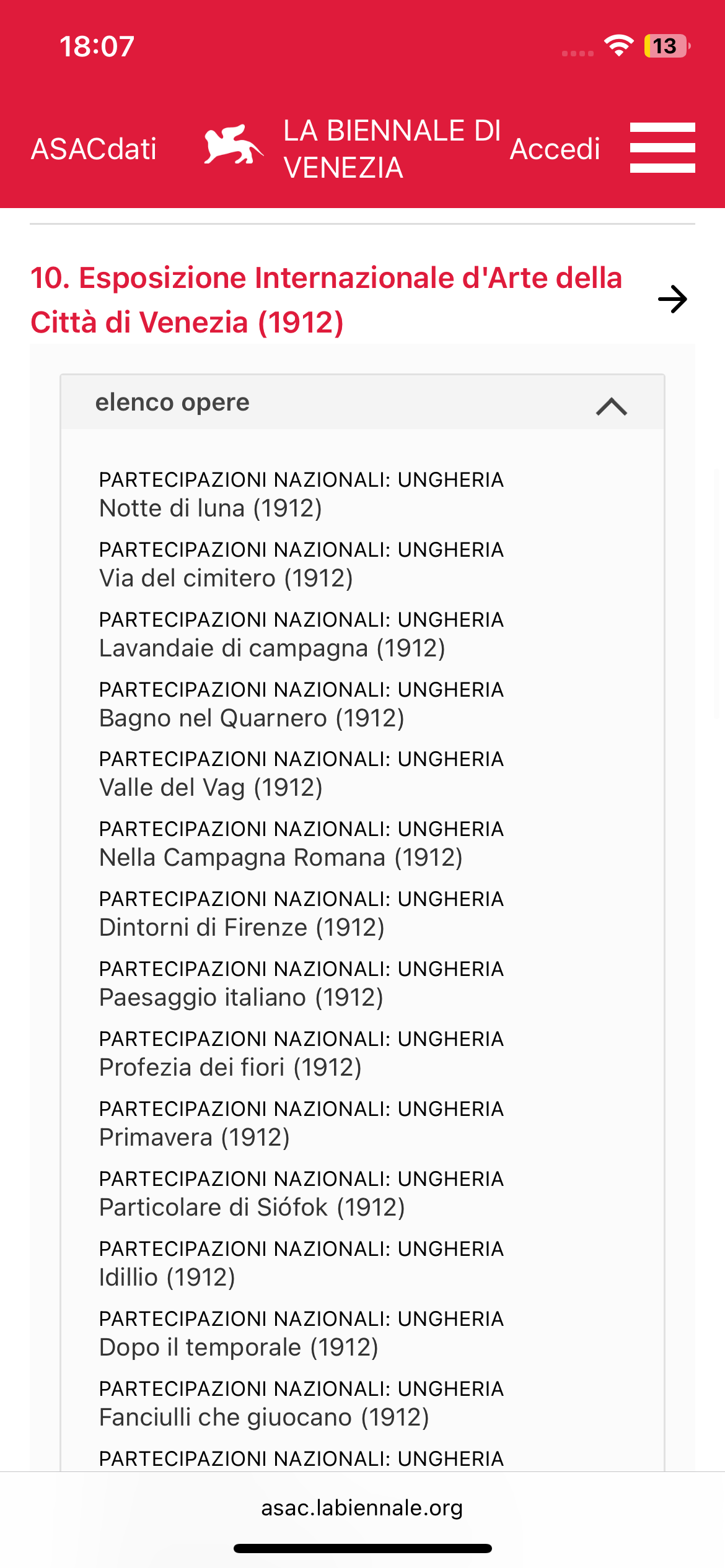
Image with text
Pair text with an image to focus on your chosen product, collection, or blog post. Add details on availability, style, or even provide a review.